Why did the AI Identity Platform ARGOS update?
As generative AI technology continues to advance, security threats are also evolving rapidly. New forms of cyberattacks leveraging AI have become a serious concern, especially for businesses and public institutions. A recent report from the Ministry of Science and ICT and KISA predicts that cases of fraud and malicious code generation using AI will increase significantly starting next year. Malicious tools, such as Fraud GPT, are already being traded on the dark web. As a result, companies need to thoroughly assess security risks and establish robust countermeasures before implementing AI technology. To minimize security threats, many companies have adopted facial recognition and biometric technologies for their services. However, facial recognition systems remain vulnerable to spoofing attacks that trick the system by pretending to be someone or something else. ARGOS has introduced biometric detection technology to address this issue.
Liveness Detection Method for Face Recognition: Active Liveness VS Passive Liveness
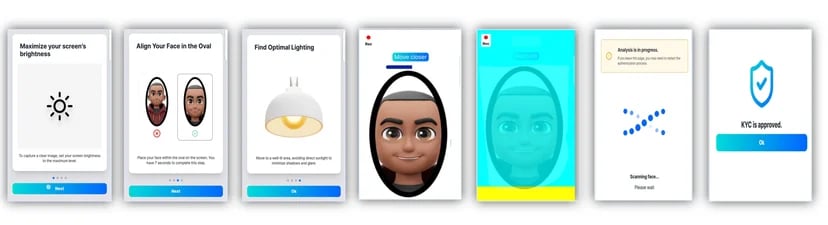
Liveness detection determines whether the person being authenticated is a real, live individual. Simply put, it checks whether someone is attempting to disguise their identity using a photo, pre-recorded video, or mask. Liveness detection methods can be broadly categorized into active liveness and passive liveness. Both methods aim to prevent spoofing attempts, but they operate differently. Active liveness is likely something you’ve encountered before—it involves asking the user to perform a specific action, such as blinking, smiling, or turning their head. Active liveness analyzes these motions or voice inputs, offering robust protection against spoofing attacks. On the other hand, passive liveness evaluates a single image or video feed to analyze factors like depth, texture, and environmental conditions. This approach leverages advanced algorithms and machine learning models to identify subtle details that signify the presence of a live individual. In simpler terms, passive liveness determines whether a person is alive and present in real time without requiring them to perform any specific actions. In summary, the differences can be briefly outlined as follows: <Table: Comparison of Active Liveness and Passive Liveness>Experience the Updated Features for Yourself
As mentioned earlier, the characteristics of Active Liveness and Passive Liveness are clearly distinct, and there is no definitive answer for which is better! The right choice depends on your company’s specific environment. ARGOS strengthens multi-factor authentication by offering both options, allowing you to tailor the solution to your enterprise needs. Compared to the existing Passive option, the Active option provides the following advantages, utilizing more sophisticated Auto-Capture technology:- Improved Accuracy: More effectively detects deepfake and forged submissions.
- Cost Efficiency: Delivered at a usage fee up to 40% lower than the existing performance of Passive.
- Enhanced Security: Boosts your company’s credibility with the industry’s highest level of authentication accuracy.
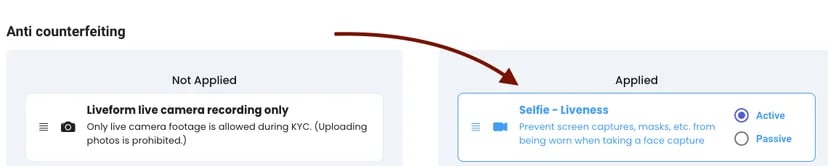
You can configure this feature by following these steps:
[Settings → Multi-Verification & Anti-Fraud → Selfie-Liveness → Set Active and Save]