

What Has Actually Changed? Ban on Self-Declared Age & Stronger Age Verification Requirements
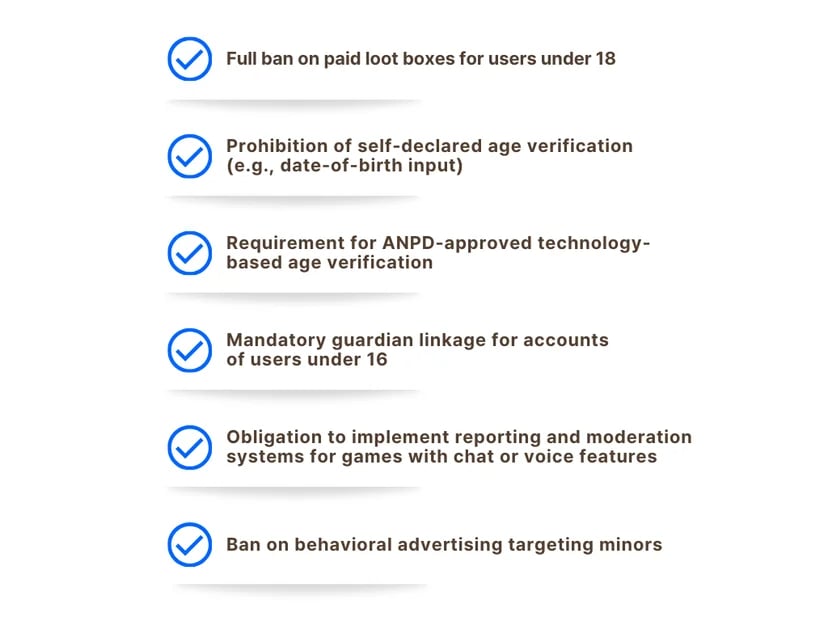
The new regulation includes several provisions that directly impact the gaming industry. One of the most structural changes is the prohibition of self-declared age verification. Simply asking users to input their birth year may no longer qualify as a meaningful protective measure. The law effectively clarifies a critical distinction:collecting age information is not the same as verifying age.
A Note on Loot Boxes
A loot box refers to a game mechanism in which users pay for virtual items with randomized outcomes. Because results are probability-based and rare items may carry significant value, these systems are similar to “probability-based items” widely discussed in other markets. Due to concerns about overspending and addiction among minors, many countries have introduced regulations. Brazil now prohibits paid random reward boxes for users under 18.The Core Question: Not Technology, but “Verifiability” The Role of Global eKYC
The essence of Brazil’s regulation is not about enforcing a specific authentication method. Instead, regulators will evaluate whether businesses can prove they took meaningful steps to protect minors. If a minor accesses paid loot boxes and the age check relied solely on self-declaration, such measures may be considered insufficient. Regulators are likely to assess not whether a process existed, but whether effective protection was realistically possible. Penalties may include:- Fines of up to 10% of group revenue, or
- Up to BRL 50 million
- In severe cases, potential suspension of services in Brazil
Brazil Regulatory Compliance & Digital Identity Verification Strategy
The law has extraterritorial reach. Even without a Brazilian entity, if Brazilian minors can access your service, you may fall under its protection obligations. Industries most likely to be affected include:- Global publishers
- Games operating probability-based monetization models
- MMORPGs with chat or voice functionality
- Web3 gaming platforms
- Subscription-based gaming services
How do you reliably verify adulthood? The regulation’s symbolic ban on paid random reward boxes for minors may appear to target monetization structures. But fundamentally, it evaluates whether companies can genuinely distinguish minors from adults. Age verification is no longer an optional onboarding feature.
It is becoming a compliance-critical component embedded in overall service architecture.

- Is our service accessible to Brazilian minors?
- Are we relying solely on self-declared age input?
- Can we implement guardian-linked verification structures?
- Have we reviewed compliance standards aligned with ANPD expectations?
What Should Companies Prepare? Why Is eKYC-Based Age Verification Being Reconsidered?
Brazil’s minor protection law does not mandate a specific technology.But it asks a direct question “Can your service genuinely distinguish minors from adults?” In an environment where self-declared input is no longer sufficient, age must be verified not merely collected. For global game operators, this is not a single-country response issue. It requires a scalable framework capable of adapting to multi-jurisdictional regulatory environments. Key requirements include
- Liveness-based verification to confirm real user presence
- Global ID document recognition and forgery detection
- Flexible policy design based on age segmentation
- Refresh or re-verification capability in response to regulatory updates
It becomes a risk management infrastructure capable of demonstrating regulatory compliance. Global eKYC frameworks such as those provided by ARGOS combine ID-based age verification, Face Liveness detection, and flexible policy architecture to help companies clearly demonstrate that they have taken sufficient protective measures. Ultimately, this is not about adopting technology for its own sake.
It is about building an operational structure capable of explaining and defending your compliance decisions. March 17, 2026 is not just an enforcement date.
It may become a pivotal moment for global game companies to reassess their age verification systems. If Brazilian users can access your platform, now is the time to proactively evaluate whether your current age verification approach can withstand regulatory scrutiny. ARGOS supports global gaming and platform companies in designing regulation-aligned age verification and eKYC frameworks. If you are evaluating your Brazil compliance strategy, now is the time to start the conversation.