
Why Is AX Different from Simple AI Adoption?
Many companies still use AI and AX interchangeably. But in reality, the two concepts are fundamentally different. Traditional AI adoption focuses on adding specific functionalities. For example : Deploying OCR for document recognitionImplementing chatbots for customer service
Connecting AI models for analytics AX, however, is much closer to redesigning operational structures themselves around AI. In other words, it is not simply about using AI tools.
It is about restructuring workflows so operations themselves can function through AI-driven execution. Today, companies frequently encounter challenges such as: Multiple AI services operating separately without connected data flows
Repeated development work whenever operational policies change
AI-generated results existing without connecting to real decision-making processes
Department-level AI adoption increasing operational complexity
Human review processes remaining despite AI adoption This means the core of AX is not the AI model itself, but how AI can be connected and executed within actual operations. And this is exactly where AI Workflow is becoming increasingly important.
Why Are Companies Now Focusing on AI Workflows?
Enterprise operational environments are becoming increasingly complex. Organizations are now managing multiple SaaS platforms, external data sources, global users, and rapidly changing operational policies simultaneously. Especially for global businesses, country-specific regulations, user types, data structures, and risk standards continuously evolve, making it difficult to manage operations using isolated AI functions alone. In practice, companies often use multiple AI capabilities together within a single workflow: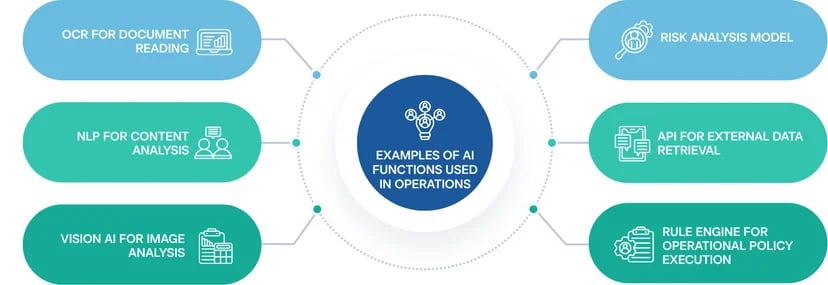
Deciding what conditions trigger the next step
Choosing when additional data should be retrieved
Deciding which cases require human review In other words, companies are beginning to realize that operational flow orchestration is becoming more important than the AI models themselves. And this is precisely why AI Workflow is becoming such a critical concept in AX.
Why Can Omni Be Considered an ‘AI-Native Workflow Platform’?
ARGOS Omni is not simply an AI feature platform. Omni is designed as an AI-Native Workflow Platform that enables AI functions, data flows, and operational policies to be connected and executed within real operational environments. Rather than offering a single AI model, Omni enables companies to design operational structures themselves through workflow-based execution. For example, companies can use Omni to define: Which data should be analyzed firstWhich conditions should trigger branching logic
Which external systems should be queried
Which results require human review
How operational reports should be generated The important point is not simple automation. It is the ability to manage operational policies themselves as workflows. In other words, Omni is not designed around isolated AI features.
It is designed to allow entire operational environments to move through AI-driven workflows. And this is exactly why Omni is increasingly being discussed as an AX platform.
The Future of AX May Become a Competition of Operational Structures, Not AI Models
AI models will continue expanding rapidly. OCR, NLP, AI Agents, Vision AI, voice analysis, and risk analysis technologies will all continue evolving. However, the more important challenge for enterprises is something else entirely: How to connect and manage these AI systems inside real operational environments. Going forward, companies are likely to face challenges such as: Operational complexity increasing as more AI services are introducedOperational policies changing faster than systems can adapt
Department-level AI adoption causing data fragmentation
Large volumes of AI-generated insights failing to connect to real decision-making
Human review workloads continuing to grow despite automation efforts Ultimately, the core of AX is likely to shift away from simple AI adoption toward redesigning operational structures themselves around AI. And as this transition continues, the importance of AI Workflow and AI-Native operational platforms will only continue to grow.